
To speak with a Recovering Addict call 619-584-1007 (San Diego County) or 442-456-1168 (Imperial County)
Para hablar con un adicto en recuperación, llame 619-546-0774

Drug Problem? Give yourself a break.
Narcotics Anonymous is a nonprofit fellowship or society of people for whom drugs have become a major problem. Whether you’re new to our fellowship or returning after time away, we’re glad you’re here!
Just for Today
October 27, 2026
Living in the present
Page 313
"We want to look our past in the face, see it for what it really was, and release it so we can live today."
Basic Text, p. 29
For many of us, the past is like a bad dream. Our lives aren't the same any more, but we still have fleeting, highly charged emotional memories of a really uncomfortable past. The guilt, fear, and anger that once dominated us may spill into our new life, complicating our efforts to change and grow.
The Twelve Steps are the formula that helps us learn to put the past in its place. Through the Fourth and Fifth Steps, we become aware that our old behavior didn't work. We ask a Higher Power to relieve us of our shortcomings in the Sixth and Seventh Steps, and we begin to be relieved of the guilt and fear that plagued us for so many years. In the Eighth and Ninth Steps, by making amends, we demonstrate to others that our lives are changing. We are no longer controlled by the past. Once the past loses its control over us, we are free to find new ways to live, ways that reflect who we truly are.
Just for Today: I don't have to be controlled by my past. I will live this new day as the new person I am becoming.
Copyright (c) 2007-2026, NA World Services, Inc. All Rights Reserved

Spiritual Principle a Day
October 27, 2026
Accepting All of Me
Page 310
"We make peace with ourselves--with all we have gained, and lost, and learned, and become."
Living Clean, Chapter 1, "A Vision of Hope"
WHO AM I?
As cliched and psychobabbling as that question may seem, many of us will identify with having asked it--and having not known the answer. Or, more to the point, we didn't want to know.
In active addiction, many of us could have answered the question like this: "Anyone you want me to be, baby."
And right after getting clean, "Nobody!" might have been the most accurate response, considering the shame we were feeling and how invisible we wanted to be in meetings.
Denial had kept us from accepting the truth of our actions and their impact on ourselves and the people who love us. Many of us paid the price for this lack of self-awareness with the loss of relationships, careers, assets, even our freedom.
The recovery process allows us to start contemplating our true identities, and it takes all the honesty we can conjure up, along with a healthy dose of courage and humility. We learn to accept that we've caused pain and injury, have done damage to ourselves and others while on our destructive paths. We also learn to accept that we aren't the sum total of those actions.
Recovery affords us the opportunity to use the hardships we've endured to help others. We divulge our deep personal struggles--those from our past and those that will inevitably arise while clean--in order to deepen our relationships with other addicts. In doing so, we show our fellow addicts that we can stay clean--no matter what.
Today I strive to accept who I am, what it took to get here, and where I am now. My past does not own me. Instead, I will use it as a tool to help others.
Copyright (c) 2007-2026, NA World Services, Inc. All Rights Reserved

Looking for a Service Commitment?
You can post ads for open service commitments for your meeting, area, or region.
Looking for a service commitment? Browse for open service commitments.
Featured Event
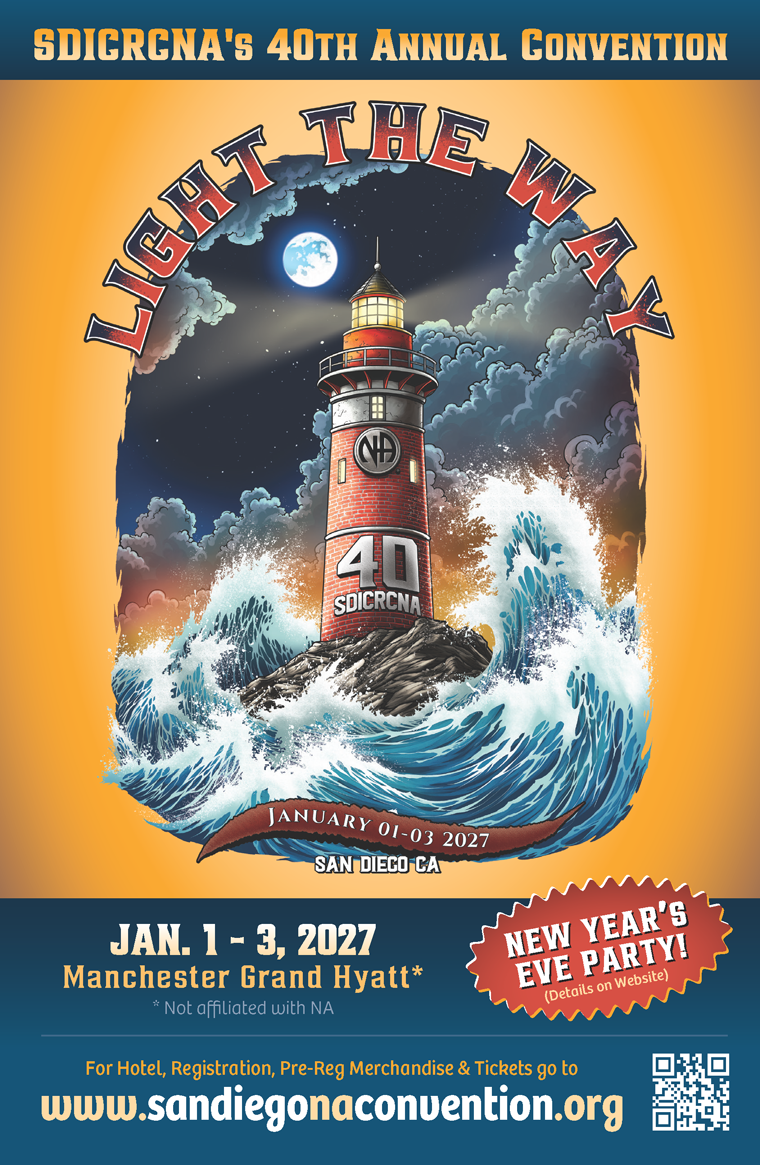
SDICRCNA 40th Anniversary
Join the San Diego Imperial Counties Regional Convention of NA as we celebrate a milestone 40th Convention, January 1–3, 2027 *Even though we are holding [...]
Upcoming Events
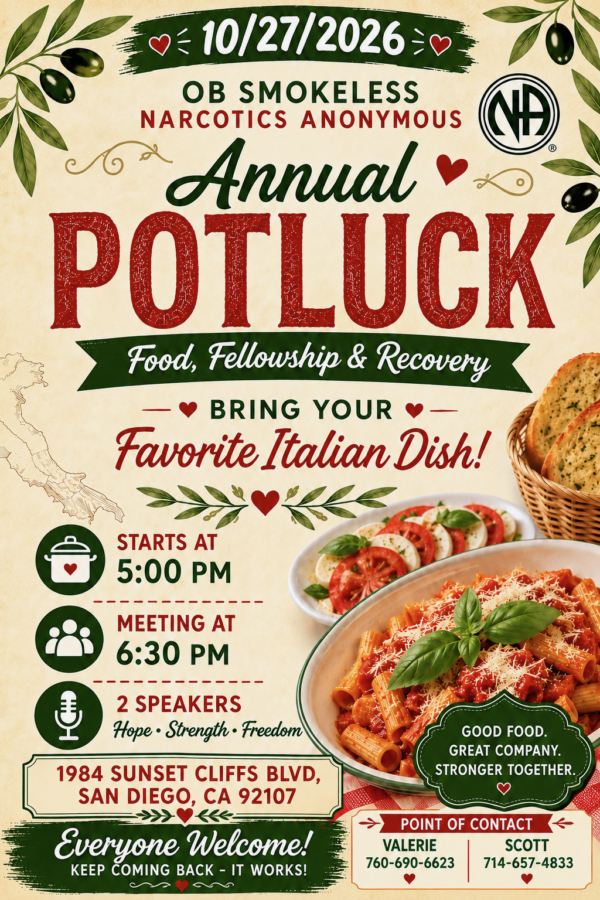
OB Smokeless Potluck
Oct. 27 5pm. 630 Speaker Meeting. Having an Italian theme potluck. Address: 1984 Sunset Cliffs blvd, San Diego, 92107 Location: Church Hall
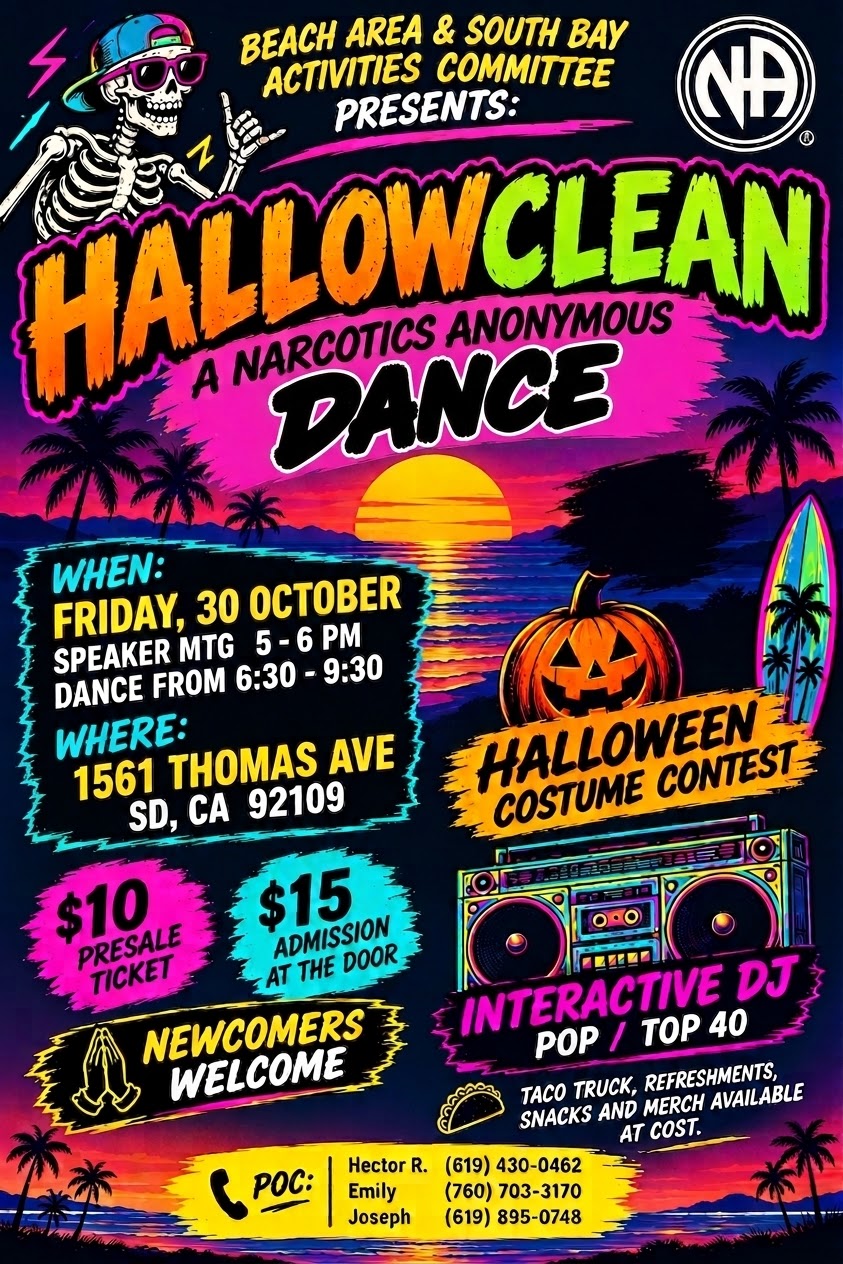
HALLOW-CLEAN DANCE
BEACH AREA & SOUTH BAYACTIVITIES COMMITTEE PRESENTS:HALLOW-CLEANA NARCOTICS ANONYMOUS DANCE SPEAKER MTG 5 - 6 PMDANCE FROM 6:30 - 9:30 $10 PRESALE TICKET$15 ADMISSION AT [...]
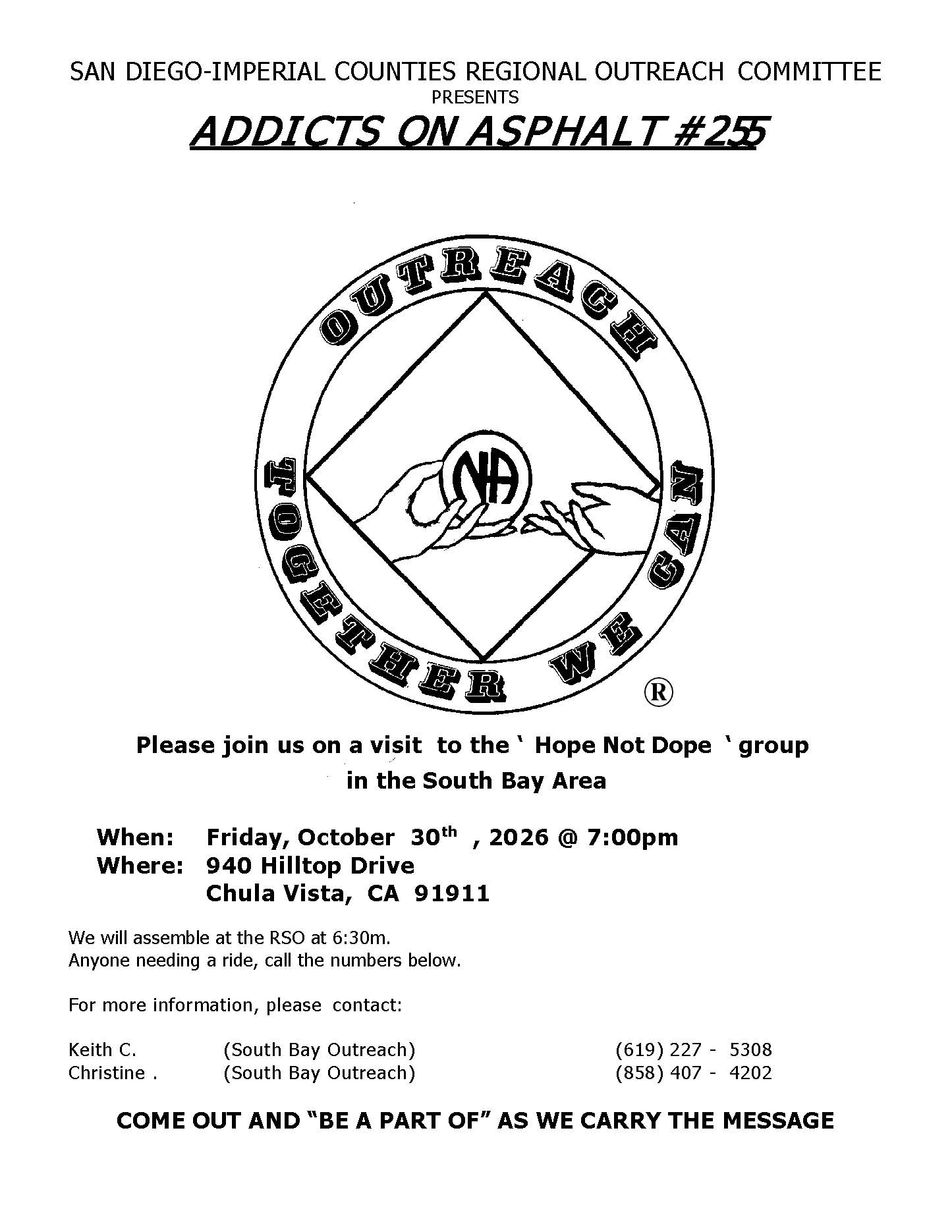
Addicts on Asphalt # 255 "Hope Not Dope"
Outreach events and teams visit NA groups to bring support, raise awareness of needs, and encourage participation in NA service. Address: 940 Hilltop Drive, Chula [...]
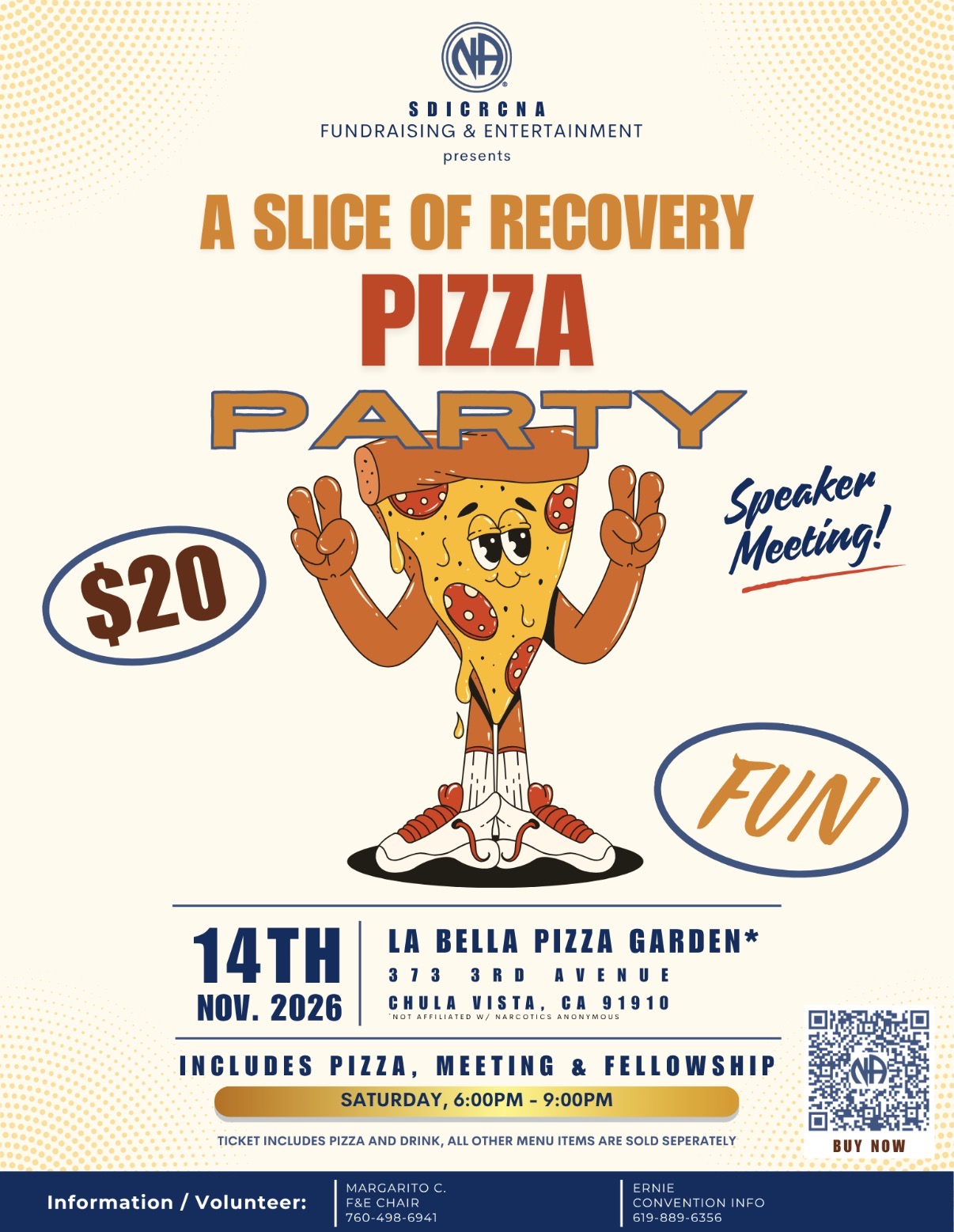
Slice of Recovery Pizza Party
Come and join us for a Slice of RecoveryWe have 2 great speakers lined upSo bring your appetite and join the fellowshipAll are welcome Address: 373 Third Avenue, [...]
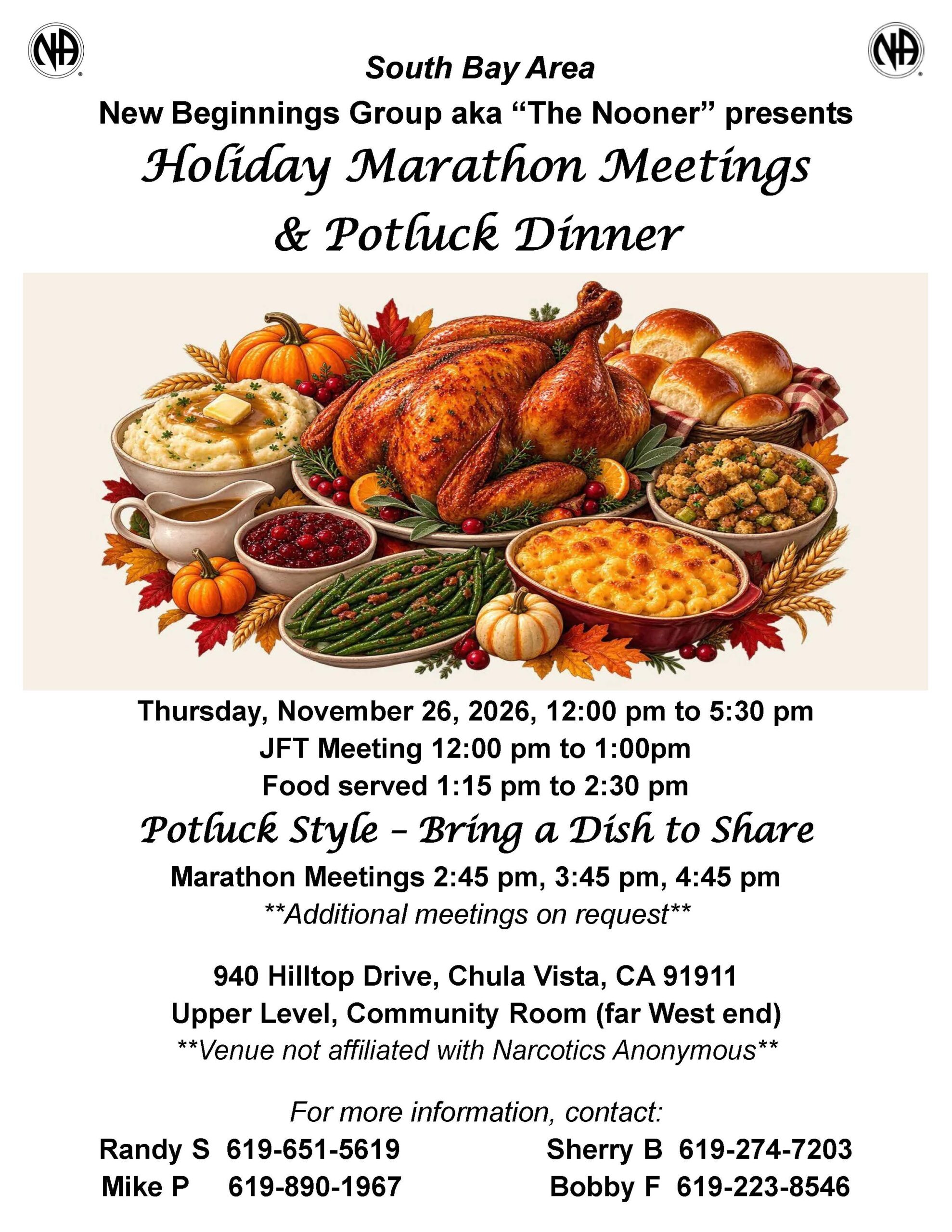
Holiday Marathon Meetings & Potluck Dinner
JFT Meeting 12:00 pm to 1:00pmFood served 1:15 pm to 2:30 pmPotluck Style – Bring a Dish to ShareMarathon Meetings 2:45 pm, 3:45 pm, 4:45 [...]
12
Dec
Holiday Bingo Speaker
Holiday Bingo Speaker Address : TBD Contact Info: Juawana - Women's Retreat Fundraising/Entertainment Chair - (619) 335-0869